|
People moving to Brooklyn often want advice on safety: which neighborhoods, or parts of neighborhoods, are safer()? The answer: it's tricky, because gun violence, for example, is more prevalent late at night, and among people--notably gang members or wannabes--who know each other. And it's also somewhat more prevalent near public housing complexes, though most residents try to live decent lives on limited incomes and 42% of households work. That said, a May 2024 New York Times interactive feature on gun violence shows some sharply divergent results for Brooklyn, including clusters of violence and areas with few shootings. Those clusters include, on my annotated map below, public housing complexes in Fort Greene/Downtown Brooklyn (pink--purple arrow) and in Red Hook (light blue arrow), in the western part of the borough. Turning toward Central Brooklyn, the south central part of Bedford-Stuyvesant (dark blue arrow) and the western part of Crown Heights (dark purple arrow), also have a somewhat elevated record of shootings, even as those neighborhood gentrify steadily. Finally, the darker-red highlights on the map indicate neighborhoods with concentrations of poverty and violence, notably southeast Crown Heights and Brownsville. There's a deeper story here about the lingering effects of inequitable development in Brooklyn, told notably in Craig Steven Wilder's A Covenant with Color: Race and Social Power in Brooklyn. 
0 Comments
 Photo by Norman Oder Photo by Norman Oder You might be wondering what I think of the recent "36 Hours in Brooklyn" travel section feature, which the New York Times published June 6, or its two predecessors, published in 2011 and 2017.
The answer: they're all useful, but need to be seen as guidelines rather than prescriptions. In 2017, I critiqued that year's incarnation for unwise broad generalizations but my biggest quibble concerned the pursuit of breadth over depth. If you followed the 2017 advice, you'd traipse through DUMBO and go to the Brooklyn Roasting Company but not the chocolate shop Jacques Torres, which is a neighborhood gem and does have coffee. I recommended a more concentrated effort to get more out of your surroundings. This year's version The most recent feature is somewhat better, but still suffers from trying to do too much. The article scants the amount of time, effort, and money--public transit, bike, car service--it takes to get between neighborhoods and in some cases offers unwise sequences. Let's take a closer look. "This itinerary skips the most touristy and overdeveloped areas, including Williamsburg and Dumbo, and requires no restaurant reservations or advance planning," writes Ingrid K. Williams. OK, but one of the restaurants recommended, Untable in Carroll Gardens, is tiny and already very hard to get into. (I've only been for lunch.) Why not offer an alternative? If you're new to Brooklyn, it's still worth visiting Williamsburg--not every part is touristy--especially if, as the article suggests, you should start your Saturday in Greenpoint. The neighborhoods are adjacent. I always recommend tackling Brooklyn neighborhoods in clusters. You could easily spend the whole day in Greenpoint and Williamsburg. Why just visit a bakery, a coffee shop, and Transmitter Park in Greenpoint? I lead walking tours of 2.5 hours--sometimes far longer--in Greenpoint, because there's so much more to see. Logistics, logistics Wait a sec, though: if you're doing this itinerary on a Saturday, as recommended, the G train--the only subway to Greenpoint--won't stop there from June 28 through Aug. 12. If your next stop is Fort Greene, as recommended, after Greenpoint, the G train won't be stopping there between Aug. 12 and Sept. 3. Let's pretend the G train is working. Rather than take the recommended route--Greenpoint to Fort Greene to Clinton Hill to Bedford-Stuyvesant, before going to the Brooklyn Museum--someone attempting this unwise breakneck pace should rather get out first in Bed-Stuy, which is the closest to Greenpoint, then Clinton Hill, then Fort Greene. Bed-Stuy's a huge neighborhood. The article suggests a first stop at the bookstore Word is Change, then the nearby boutique Byas & Leon. OK. Then "refuel a few blocks away at A&A Bake Doubles and Roti," which, unmentioned, is a 9-minute walk. Then it's a 13-minute walk (unmentioned) to BLK MKT Vintage, and an 8-minute walk to Black Star Vinyl. The final stop, Fan-Fan Doughnuts, is--unmentioned--a 27-minute walk! But there's so much more to see in Bed-Stuy. Fan Fan is relatively close to the Pratt Institute in Clinton Hill: a 12-minute walk. B Then there's far more to see in Clinton Hill--wide streets and mansions, before exploring eclectic Fort Greene. Whether you take the Times's advice or mine, it's still a ridiculous plan. Carve out more time for the Brooklyn Museum, the adjacent Brooklyn Botanic Garden, and the adjacent neighborhoods of Prospect Heights, Crown Heights, and Flatbush. Stick around the area for dinner instead of trying to get to Bushwick for dinner, which Google suggests is a 37-minute trip from the museum, at least if you catch the 3 train--which comes every 12 minutes--in a timely manner. Hey, the best way to Bushwick, on the L train, is from... Williamsburg. The bottom line Brooklyn needs more than 36 hours and bears repeat visits. If you only have a little time, think adjacencies. I just checked the reader comments on the article, and the second-most popular one--after a nice anecdote--stated, "Lots of great spots featured but this itinerary is a bit ridiculous and has you hopping around in all kinds of directions and doubling back and forth between general sections of BK." Amen. The Brooklyn Bridge is pretty glorious, right? It's a marvel and an icon. Truth be told, I never loved leading a "Brooklyn Bridge tour" because, given crowds, walking the bridge can be a frustrating experience for all but small groups. Recently, though, I've concluded that it's not enough to walk the bridge and tell the story of the bridge. It's crucial to see the bridge from various angles in both Manhattan (photo below) and Brooklyn, and to look at the art and photography it has inspired. So I've revised and renamed my tour as Viewing (and Walking) Brooklyn Bridge, and More in Brooklyn and Manhattan.  People sometimes ask me: what books are good preparation for a trip to Brooklyn?
The answer: there's no single definitive volume of non-fiction, much less fiction. And some books are centered in particular neighborhoods. Here's are a couple of preliminary lists, which I will update. NON-FICTION Fodor's Brooklyn. Dated but somewhat useful neighborhood guidebook. Out of print; available used. Brooklyn: The Once and Future City, Thomas Campanella. Great tales of less-heralded Brooklyn, but ends before the present day. The Great Bridge, David McCullough. The definitive history of the Brooklyn Bridge. A Covenant with Color: Race and Social Power in Brooklyn, Craig Steven Wilder. A definitive--as of its 2001 publication date--study of inequitable development. Could use an update. The Boys of Summer, Roger Kahn. On the Brooklyn Dodgers. When Brooklyn Was the World, 1920-1957, Elliot Willensky. The best on nostalgia. An Architectural Guidebook to Brooklyn, Francis Morrone. Great on neighborhoods, but 2001 publication date means it could use an update, especially regarding Downtown Brooklyn. The New Brooklyn: What It Takes to Bring a City Back, Kay Hymowitz. A useful but incomplete (and sometimes contestable) account of Brooklyn's recent fate and future. Coney Island Lost and Found, by Charles Denson. The best history of Coney. A Walker in the City, Alfred Kazin. Working-class Jewish striving, from Brownsville. FICTION (past) A Tree Grows in Brooklyn, Betty Smith. An unlucky but plucky girl in Williamsburg, early 1900s. The Chosen, Chaim Potok. 1940s Williamsburg, Modern Orthodox and Hasidic Jews. Brown Girl, Brownstones, Paule Marshall. Barbadian family in Bed-Stuy, in the 1950s. FICTION (more recent) The Fortress of Solitude, Jonathan Lethem. Gentrification's early days, when Gowanus became Boerum Hill. Pineapple Street, Jenny Jackson. Rich people problems in Brooklyn Heights. Brooklyn, Colm Toibin. An Irish immigrant young woman in the 1950s. Another Brooklyn, Jacqueline Woodson. Black Bushwick in the 1970s. Dreamland, Kevin Baker. Old Coney Island, a very unusual place. Prospect Park West, Amy Sohn. Not-quite-rich people problems in Park Slope. What’s right, and wrong, with those “Top Ten” or “Top 20” lists of things to do or visit in Brooklyn?
Quick here’s one from TripAdvisor, another from Time Out New York, another from U.S. News and from two other websites. Well, for people new to Brooklyn, they can be helpful summaries that clarify what many think are worthwhile activities. (There are also some oddballs in there. The Royal Palms Shuffleboard Bar & Club is a fine—and unique—place to visit, but I wouldn’t put in a Top 20 list. But I'm no longer young. Similarly, Brooklyn Crab in Red Hook is worth a visit, but it shouldn’t be the only thing on your Red Hook list. Yes, I lead tours there.) DIY or with a guide? All these attractions indeed can be visited on your own, without a tour guide. However, a tour can add far more context, historical photos, and fine-grained insight to neighborhoods like DUMBO, Brooklyn Heights, Park Slope, and Williamsburg. A tour guide can help on the Brooklyn Bridge, but it’s so crowded it may not be worth it, so I don't push my services. Even a place like Coney Island, where the iconic boardwalk is free, with views of (in-season) rollercoasters like the Cyclone and Thunderbolt, plus the Wonder Wheel, deserves a deeper understanding. Fitting things in The lists also include locations of vastly different sizes. The Brooklyn Heights Promenade (on my Brooklyn 101/202 tours, as well as Brooklyn Heights & DUMBO), is smaller than Brooklyn Bridge Park, which is far smaller than Prospect Park. Moreover, any list is not geographically conceived, so people new to Brooklyn don’t know how different attractions related to each other. I always recommend that people aim to visit neighborhoods that are adjacent or—sometimes more complicated to newbies—within easy connection by subway or bus. If you book me for a tour, I can make recommendations, but here's a start. Clusters of culture So if you’re visiting Prospect Park, that’s when to also consider the Brooklyn Museum, the Brooklyn Botanic Garden, and the Brooklyn Public Library’s Central Library, all clustered around Grand Army Plaza, which is the park’s northwest gateway. For those choosing my Brooklyn 101 or Brooklyn 202 tours, which include a stop at the library (if it’s open), we can start or end near the museum, so it’s possible to visit the museum and the garden. (Note: my tours go into the park, but I leave others to lead comprehensive tours of the park.) The New York Transit Museum, which is not near Prospect Park, is a less-known gem, so I’m glad it’s on some lists. It’s close to Brooklyn Heights, Downtown Brooklyn, and Cobble Hill/Carroll Gardens, so it can be a springboard to my tours. The Brooklyn Academy of Music is central to another cultural cluster in Fort Greene, including three BAM buildings, a theater, and smaller cultural spaces. We can easily start or end near there. Food and drink The Brooklyn Brewery and Kings County Distillery are fine places to visit, but there are so many microbreweries in Brooklyn that it’s a shame to limit yourself. In fact, it would make sense to organize a geographic “crawl,” given clusters of breweries in Gowanus, Red Hook, and Bushwick. (Williamsburg, home to the Brooklyn Brewery, does have another craft brewery, Ebbs, in walking distance.) Many sources recommend the weekend food fest Smorgasburg, which is indeed worth a visit (in Williamsburg and Prospect Park, in-season) for convenience and creativity, though don’t expect great bargains. Two indoor food halls, Time Out NY Market (in DUMBO) and DeKalb Market (in Downtown Brooklyn), are also worth visiting and can be incorporated into my tours, either within the tour, or at the end. Some lists recommend organized food tours. If food and convenience are your priority, fine, but if you want to see more things, it’s typically possible to incorporate food into a more comprehensive neighborhood tour. Taking the ferry The East River Ferry indeed is a top attraction, given the views of Manhattan, Brooklyn, and Queens, but I’d recommend it most as a connection between DUMBO and Williamsburg, Greenpoint, or (in Queens) Long Island City, all worth significant exploration. Shopping Some recommend the Brooklyn Flea, which is in DUMBO in season and spawned the even-more-popular Smorgasburg. It’s worth visiting—and can be incorporated into a tour—but is hardly the only source for shopping. Similarly, L Train Vintage in Bushwick is fine, but, honestly, if you want to thrift, it’s probably wiser to walk the East Village. Larger contexts Industry City, recommended for both shopping and eating, is a worthwhile destination, but is best seen in the larger context of the nearby Sunset Park neighborhood. Similarly, if you just want to see street art, go to the Bushwick Collective (and/or take someone else's tour), but if you want to see some of the art in the larger neighborhood context, take my Bushwick tour. Sure, Domino Park in Williamsburg is worth a visit, but again I'd suggest within the larger context of the neighborhood. I recently got a tour request from a couple of seniors (from a Midwestern state in the USA) who are contemplating their first visit to New York City, bringing their 12-year-old granddaughter. They're thinking about hiring a guide for two to four hours a day over three to four days to introduce them to NYC.
That's not actually in my wheelhouse--blame the name of my company!--but it's fine that they contacted me. Below is a modified version of my response. If you look at my website, I actually do not specialize in introductory NYC highlights (Financial District, Times Square, Central Park, etc.) but rather on more focused walks around various neighborhoods, mostly in Brooklyn, and a few in Manhattan and Queens. In other words, they're generally for people who've already seen those highlights and want to go beyond. I suspect you'd probably want to spend at least two, maybe three (maybe all?) days in Manhattan. Please keep in mind that NYC is large—you can't see a lot in two hours, even if you're limited to Manhattan. There are numerous guides who could help you in Manhattan, as well as scheduled group tours. (I can lead tours in Manhattan—I did a 9-hour tour a few weeks ago that included pieces of Manhattan, Brooklyn, and Queens—but others specialize in Manhattan.) Some DIY research I'd encourage you to first buy (or borrow from the library) a guidebook, so you can figure out your priorities. In other words, you generally don't need a guide to take you around a museum. I'd also encourage you to join the Facebook group What to Do in NY and search for people reporting on what they did with a 12-year-old. Also think about how much walking you can do, and whether you'd want to cut down on distance by taking public transit (buses or subway) or taxis. Finding and paying a guide Think about your budget for a private guide: it will cost you minimum $60-$75/hour, and some guides do charge $100+/hour. If you can't find a guide recommended in Facebook or other web searches, you can always search on the Guides Association of NYC website. Or post a request for a guide (the more focused the better). What about Brooklyn? Finally, if you would like a tour of Brooklyn with me after you do the highlights in Manhattan, we could do an introductory tour: Brooklyn Bridge, DUMBO, Brooklyn Heights, etc. My fees are here (but will go up slightly in 2024), Why specialize? As noted above, I can lead introductory tours in Manhattan and did combine part of one with a larger tour that included Brooklyn and Queens. That was for a recurring client--a leader who brings 5-6 different people to New York once a year for a full day of touring! But I don't market myself for those tours because I don't specialize in those highlights. Sure, I can show you Times Square and Rockefeller Center and part of Central Park, and it will be "good enough" for new visitors. But I know some other guides are there all the time and know all the nuances. I spend a lot of time trying to keep with the complexities of all the neighborhoods (mostly Brooklyn, plus two in Manhattan and three in Queens) where I do lead tours. That said, if anyone does want a tour that combines boroughs with Manhattan, that could work. I'm happy to lead more long tours! 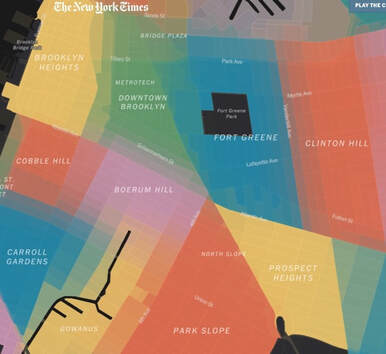 You might be surprised to learn that New York City does not have official neighborhood boundaries, and some new names have emerged as the product of re-branding by neighborhood boosters and/or real-estate agents. Here an interesting article in the New York Times about the contested boundaries.
Note, in the screenshot at left, the boundary zones where the colors aren't solid. History lessons For example, once upon a time there was an undifferentiated area of "South Brooklyn," which referred not to the southern sections of today's Brooklyn, like Coney Island or Bay Ridge, but to the southern part of the old City of Brooklyn, established in 1834, while the rest of Kings County--today co-terminous with Brooklyn--was unincorporated. By the 1960s or so, in an effort to distinguish row-house sections of South Brooklyn from nearby--but separated by a highway--Red Hook, a maritime industrial neighborhood with a massive public housing complex, those boosters conceived of Carroll Gardens and Cobble Hill. There are unusually deep front gardens in Carroll Gardens, though the only hill in Cobble Hill is historical. But it sounds more posh. New questions Today, the debates more concern the effort to expand, or contract, a border. Consider: the border of Prospect Heights, long thought of as Washington Avenue, is no longer fixed, as real estate listings a block or two east of Washington now claim Prospect Heights rather than Crown Heights. See the yellow-to-green section in the bottom right of the screenshot. The logic is that these more upscale apartments have more in common with most of Prospect Heights than much of Crown Heights, which has more working-class blocks, many with rent-stabilized units, to the east. Then again, Crown Heights also has its own historic blocks. You want to understand Brooklyn?
Well, consider this quote from a store owner, relayed by photographers James & Karla Murray, who have been on a mission to capture disappearing storefronts in the city. Katy's Candy Store was at 125 Tompkins Avenue in Bedford-Stuyvesant. That's hardly the gentrified section of Bed-Stuy, but rent for that space is now much higher. Note: I tend to speak that third language when I cross the street and encounter dangerous drivers and ebike riders. I haven't yet gotten to visit the Brooklyn Botanic Garden (and we're members!) in recent weeks, but Green-Wood Cemetery, which is within walking distance for me and where I just led a tour yesterday, offers some glorious spring flora, including azaleas, tulips, dogwoods, cherry blossoms (not shown--too late), and even a weeping beech tunnel. So the flora are a bonus, on top of the cemetery's fascinating history, rolling hills, impressive statuary, great views, and feeling of repose--achieved within a not-long walk from the busy city. 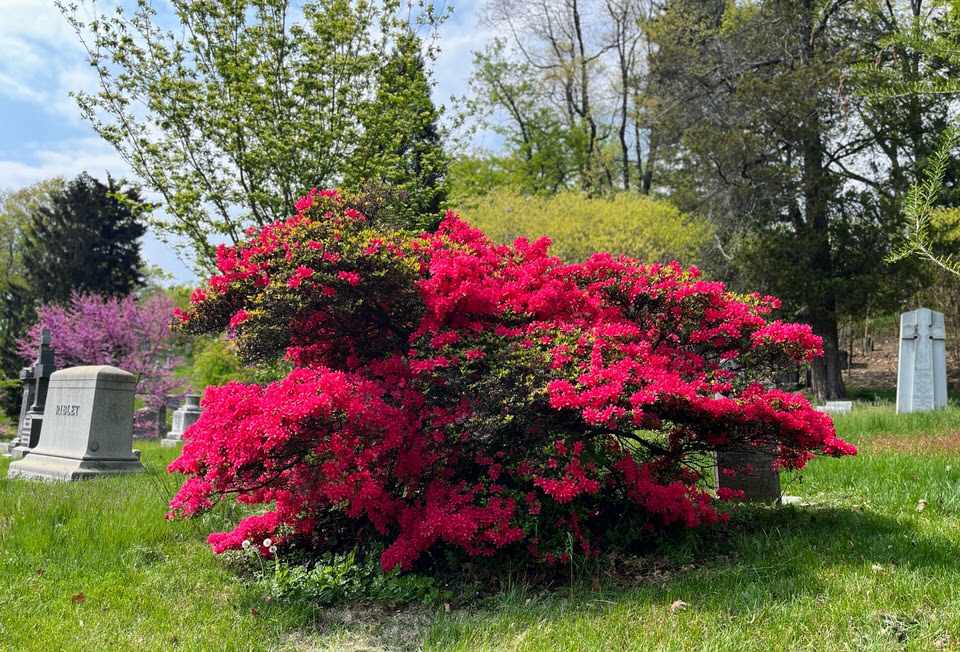 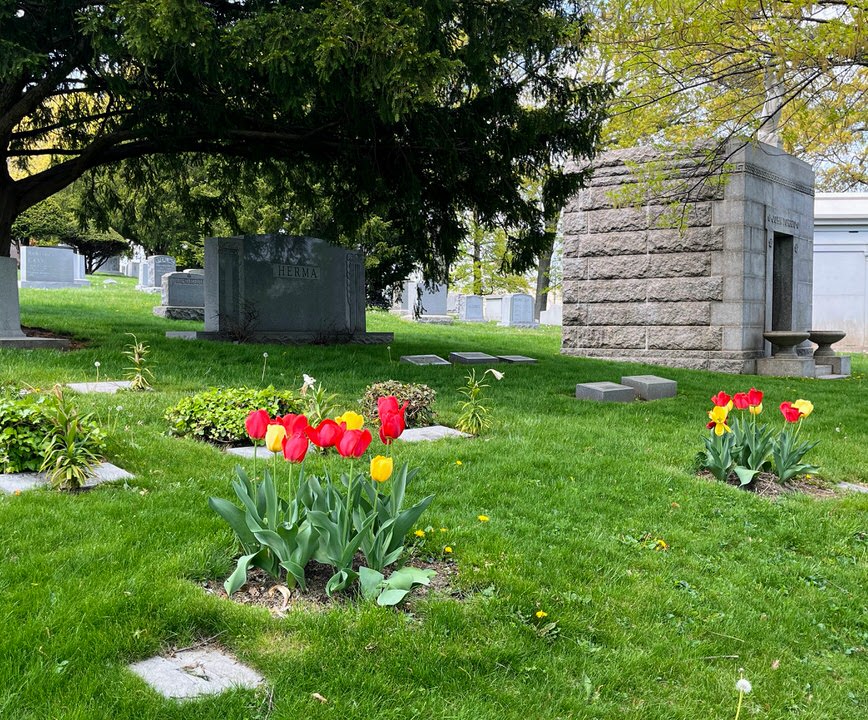 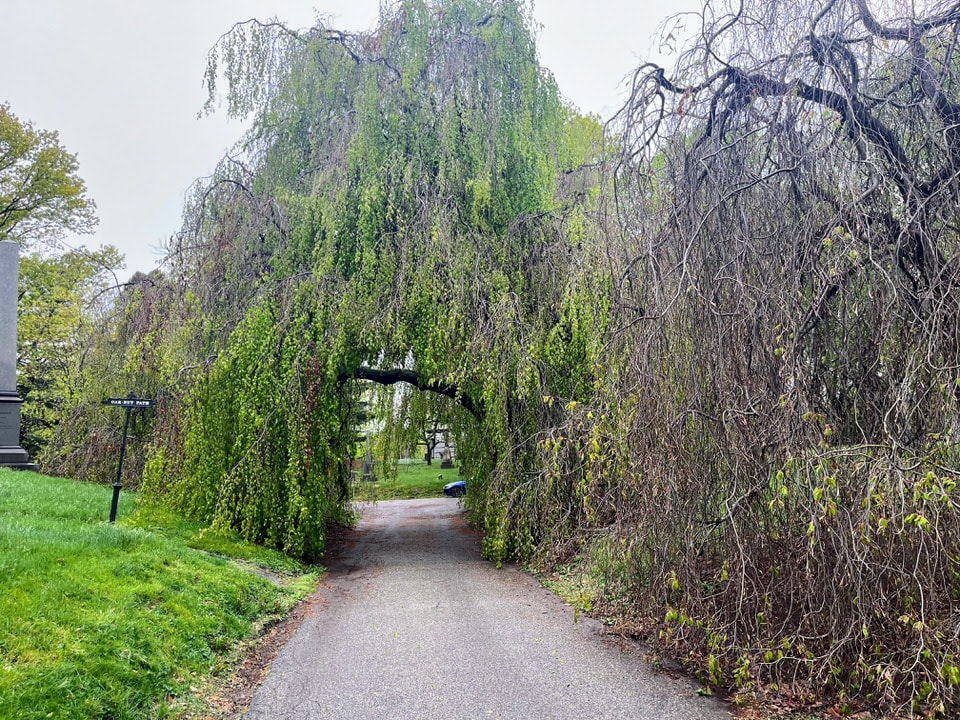 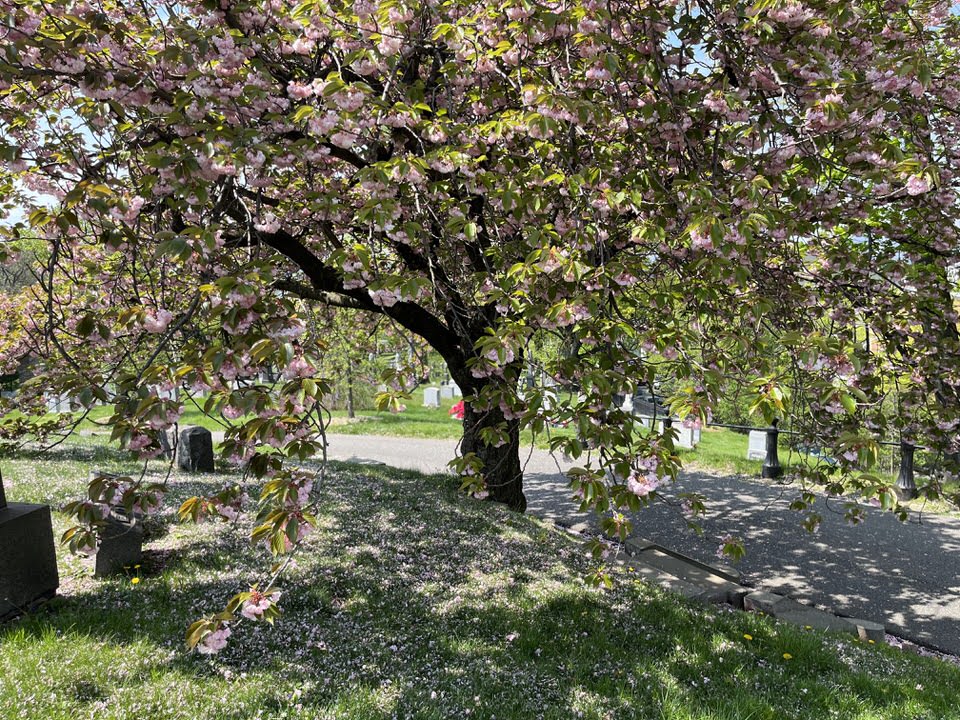 The screenshot below, from an interactive map produced by The Trace regarding gun violence in America since 2014, is pretty stunning. The red dots indicate fatal shootings; the yellow dots non-fatal ones. The shootings are disproportionately clustered in certain neighborhoods, including Brownsville, East New York, Bedford-Stuyvesant, Crown Heights, and Flatbush. A closer look shows that specific blocks--in many cases near public housing projects--are more dangerous than others. But what the map doesn't show, at least as of now, is the time of shootings. A good number are surely late at night. 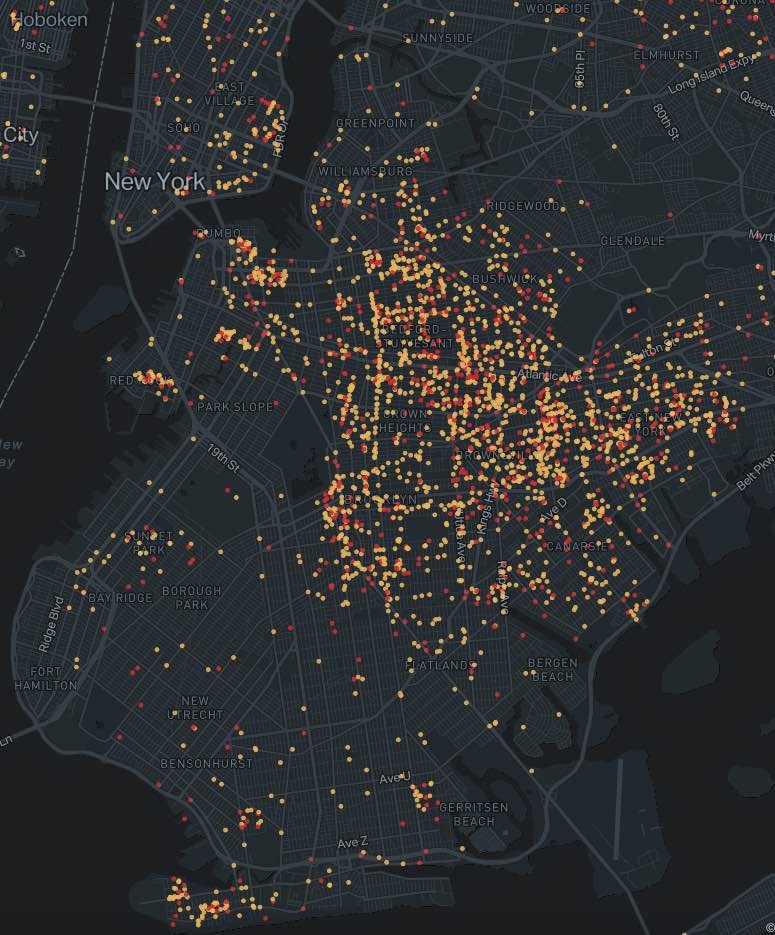 After Pandemic & Pivot to Remote Work, Kickstarter’s Former Greenpoint HQ on Sale for $29.5M2/23/2023 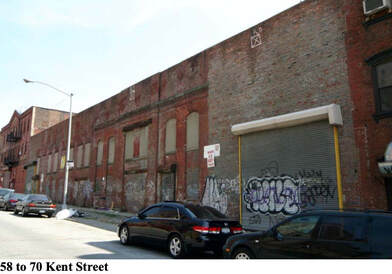 Little more than three years after its April 2009 founding, the crowdfunding site Kickstarter, basking in rapid growth and a $10 million boost from venture capital investors, agreed to spend $7.5 million to buy and renovate part of the landmarked Eberhard Faber pencil factory complex in Greenpoint. “We are hoping to stay at 58 Kent [Street] forever — to be our permanent headquarters,” Kickstarter CEO Perry Chen told Community Board 1, according to the New York Post. (Image at right, pre-renovation, from 2007 NYC Landmarks Preservation Commission report.) The Landmarks Preservation Commission hailed the adaptive re-use design by architect Ole Sondresen, with Scott Henson, which remodeled the remains of three connected 19th century factory buildings, which had been demolished above the second floor in the 20th century, and combined three facades, which had two truck bays installed. Upon the revamped building’s opening, Kickstarter and its then-80 employees held a block party, closing off Kent Street to demonstrate some projects supported by the platform, and offering tours of their workspace. (Below image from current B6 listing.) 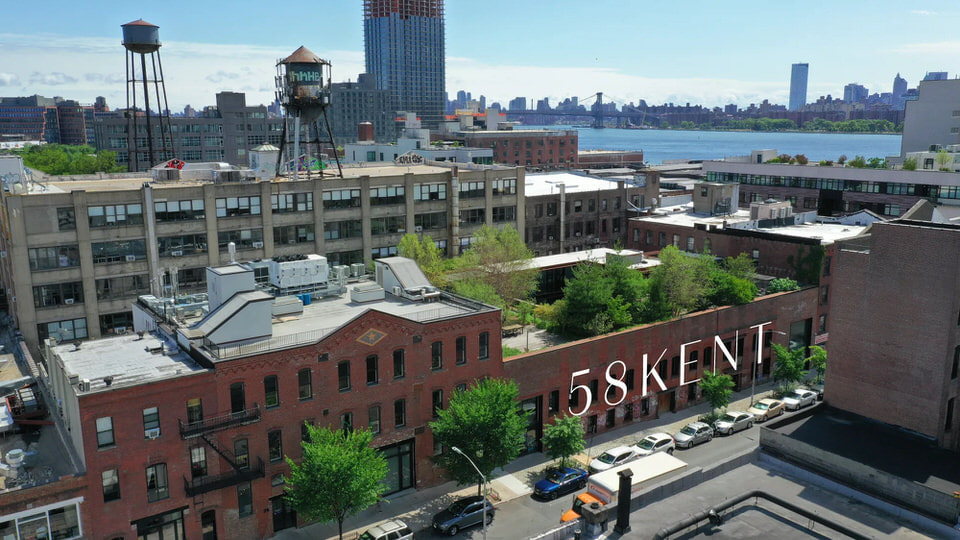 “Kickstarter's New Office Is Incredible,” pronounced Business Insider in May 2014, citing the building’s inner courtyard, garden, and library. Indeed, the adaptation included a new one-story rooftop addition, an interior glass courtyard, and new windows, with Corten steel perimeter framing, which replaced a bricked-up facade. The building offered not just office space but also a library, kitchen, gallery, and theater, using significant amounts of reclaimed wood. Just before the pandemic hit, in February 2020, Kickstarter employees voted to form a union, after a history of contention. (Below image from current B6 listing.) 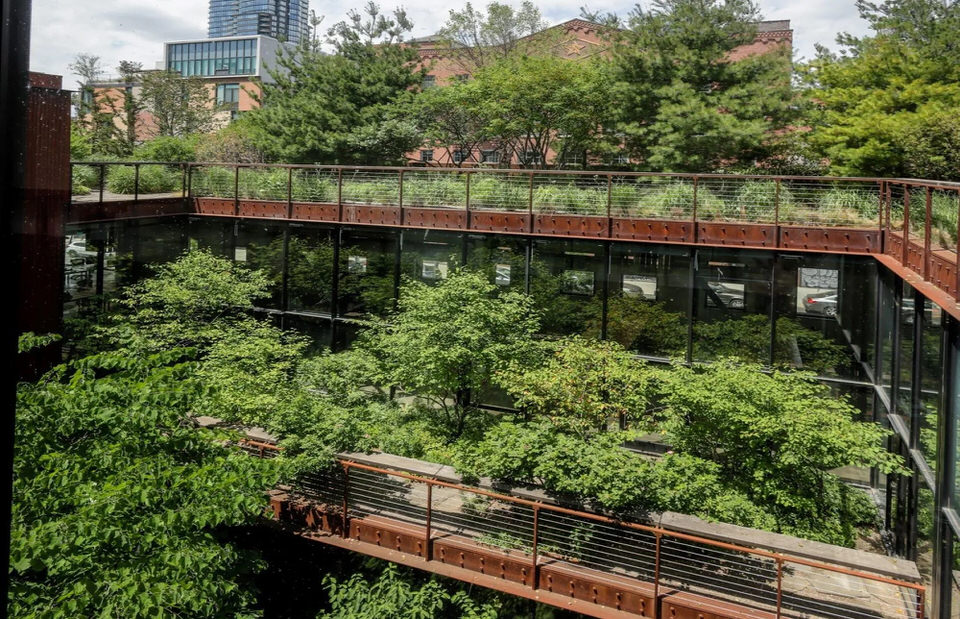 Layoffs and closing Three months later, Kickstarter announced that the COVID downturn in fundraising forced it to lay off 25 workers. The Verge reported that the total, including buyouts, was 30 people, out of nearly 140 staff; the union cited the severance package it negotiated. As work-from-home became the norm, and 58 Kent was mercilessly tagged by graffiti vandals, Kickstarter in 2021 decided to become a fully remote company. Last April, Kickstarter, then with nearly 100 employees, announced it was joining several other firms testing a 32-hour, four-day workweek and this January said it was making the Monday-through-Thursday schedule permanent. (Below photo Dec. 2, 2021, by Norman Oder) 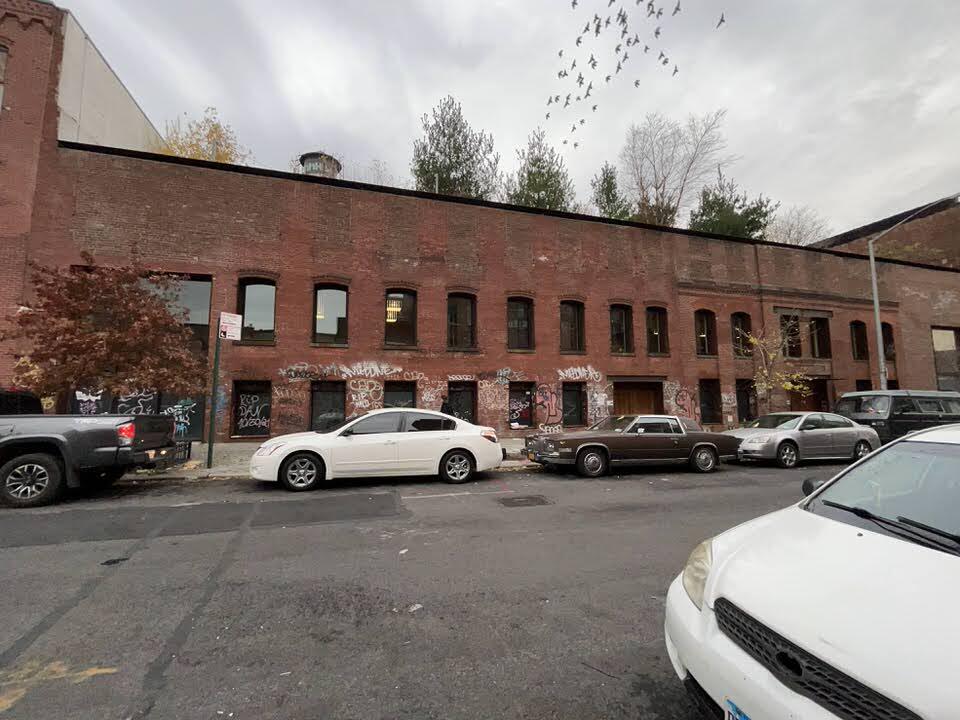 Chief Strategy Officer Jon Leland told Benefit News that the policy was helping with recruitment and retention. That pivot supplants the old strategy—offering a purpose-built headquarters in an atmospheric North Brooklyn neighborhood. Building for sale Today, 58 Kent is being marketed by B6 Real Estate Advisors as a “custom-built flagship office building,” containing 30,000 square feet of space, half a block from Franklin Street, “one of Greenpoint's most desirable retail corridors.” Citing the “exceptional natural light provided by a central, glassed-in courtyard garden,” B6 says the “property redefines the concept of going to the office, with open-air worktables, private offices, glass meeting rooms, a 2,500 square foot library, a 74-seat theater, an open-air commercial kitchen, diner-style kitchen seating, tiered wooden bleachers, and a glass penthouse” that leads to a “lushly landscaped” rooftop garden. Still, Brooklyn office space had a 17.8% vacancy rate, as of the fourth quarter of 2022, according to Newmark, and the landmarked Domino Sugar building in Williamsburg is being transformed into a 460,000 square foot office building, without an anchor tenant. So, mindful of that challenging market, B6 notes that “the property and zoning would permit conversion to an event venue, retail, gallery, or showroom, or virtually any other commercial use." And if the building sells anywhere near the asking price, it might represent a tidy profit for Kickstarter (even if the renovation costs exceeded the original budget), little more than a decade—and a world-changing pandemic—after the company’s stated aspiration of “forever.” In posts like How Not to Write a "Neighborhood Guide to Brooklyn," I've noted misguided efforts, in travel publications, to somehow propose a one-day visit to disparate parts of a vast, city-like borough.
Well, it gets worse. I just saw A Stroll Through Brooklyn: The Ultimate Guide for a Memorable Trip, which somehow describes Brooklyn as "an ever-evolving neighborhood with plenty to see and do" and then lists the following highlights: the Brooklyn Bridge, Prospect Park, the Brooklyn Museum, the Brooklyn Flea (seasonally closed, actually), and "some local cuisine." The latter two examples are DiFara Pizza, which is not located near any of the above, and Miss Lily's, which is in Manhattan. Oh well. The site, upon further inspection is called StupidDope, and it's apparently a content mill to draw eyeballs to a (not legal, though not prosecuted) cannabis delivery service. So I read an article in Eater, This Brooklyn Wine Bar Is Betting Big on Food Pop-Ups — Will it Work?, which pointed me to Ostudio at Night, which describes itself as "A 4,500 sq ft venue in Brooklyn at the conjunction of Bushwick and Bed-Stuy, two of New York’s most creative and vibrant neighborhoods."
Well, that's marketing speak to describe two huge neighborhoods that have numerous sub-neighborhoods. And the buzz you may read/hear about those neighborhoods often relates to a very small fraction of blocks, attractions, or businesses. In other words, the location of this wine bar--which may be a great place to visit!--likely has little to do with the overall creativity and vibrancy of these neighborhoods. They're just too big. If you want to get to know Bushwick or Bedford-Stuyvesant, you really have to walk around--a lot. My 2.5-hour tours, however briskly paced, only traverse part of each neighborhood. Unlike some in the world of guiding, I try to fairly transparent about pricing.
For my "off-the-shelf" tours, which are in my repertoire, my fees are based on the time (min. 2.5 hours, except for Brooklyn 101, which really needs at least 3 hours) , plus the number of people. They're not the highest fees, but they're not the lowest--I think they're fair. Custom tours require a surcharge. For a relatively simple tour--like mapping out the turns for a last-minute driving tour--I don't add much of a surcharge. (Why don't I simply wing it? Because my goal is to make the best use of visitors' time.) But complicated tours require more time. That's why I can't offer a price quote until I know the complexity of the route: for example, family reunion tours often involve several disparate addresses--homes, schools, etc.--of importance. I need to learn about those places and, yes, I need to visit them, ideally on the same day/time of the week as the tour itself. (That said, if I know the location well already, maybe I don't need to visit.) And, guess what, people's plans change regarding locations of importance, restaurants, or final destination--all of which is understandable, but can require more time from me. Or sometimes I realize that I need to put in more time than initially anticipated to do a solid job. Bottom line: in some cases, I've begun offering fee estimates in a range, with a minimum and a maximum. In other words, I'd like to charge the minimum, but might have to charge the maximum. That, I think, is a fairer process, and avoids the incentive to cut corners if/when more time is needed. For a long time, visitors to New York City had to buy a separate MetroCard at a machine and swipe it to use the subway or bus. (You can also use cash to pay for a bus.) MetroCards come in two types: stored value (pay $2.75/ride, with free transfers within two hours) or unlimited rides for a week ($33) or 30 days ($127).
You can still do all that. But you don't have to, which means you can save time. Thanks to the new OMNY reader system, you can simply use a credit card (or smartphone/smartwatch) to pay for rides; please see instructions here. And while OMNY does not (yet) offer the equivalent of a 30-day MetroCard, it does have a (limited) weekly fare-capping system. The fare cap is aimed at commuters, so it runs Monday through Sunday; that means that after 12 rides, all future rides are free. Unlike the weekly MetroCard, which you can start on any day and will run seven days, the OMNY weekly cap runs from Monday through Sunday. That means that if, for example, you start on a Friday, it will not last seven days. In that case, you'd be much better off buying a weekly MetroCard. Jane's Walk, the annual weekend of free tours (#janeswalknyc) inspired by the urbanist and author Jane Jacobs, has returned for in-person tours on the first weekend in May, so I am again offering a tour of Atlantic Yards/Pacific Park & Barclays Center, at 6 pm on Friday, May 6. Details and link for RSVP are here. Jane's Walk listings are here.
It should last 90 minutes to two hours. Unlike in previous years, you can't just show up--an RSVP to the organizer, the Municipal Art Society, is required and capacity is limited. Meeting location, ending location, and directions will be provided via email before walk date. (By the way, if any groups/classes ever want to hire me for a separate tour, I'm available.) From the blurb: Hugely controversial when proposed (in 2003) and approved, the megaproject Atlantic Yards (in 2014 renamed Pacific Park Brooklyn), still deserves attention. See what’s been built (the Barclays Center, home to the Brooklyn Nets; plus 6 of 15 towers), what’s coming (2 more towers), and what’s left (decking the railyard for 6 towers? a two-tower project?) at this crucial crossroads. Learn Atlantic Yards’ tangled history, uncertain timetable, changing designs (and ownership), and ongoing questions. Topics include public accountability, affordable housing, arena design/operations, and the changing neighborhood/Brooklyn context. We will walk around much of the perimeter of the 22-acre site, plus some adjacent blocks. Those of us living in New York City through the pandemic know that, while the subway is much safer than it was decades ago, it's less safe than it was a few years ago. To quote one recent report, the New York Police Department counted 461 underground assaults across the city in 2021, 102 more than in 2020, and the most since 1997. For perspective, a typical week has a ridership of some 20 million, or more than 3 million rides per weekday--in a huge city where the system operates 24/7. ABC reported that, according to NYPD crime numbers, the chance of being a victim of any subway crime is 1 in about 408,000. "These are very random events," said one expert, who likened the chance to being hit by a bus. So the subway is still generally safe, and most trips are uneventful. (I wrote this before the extremely rare, though of course unsettling, shooting on a train in Sunset Park, which brought more police to the subway system. And the suspect was quickly caught.) The mayor has increased the number of police patrols as well as social work teams to assist homeless people who choose the subways over the not-so-safe shelter system. But please recognize that the subway system is not the equivalent of a suburban train ride, or even the generally calm subways of many other world systems. So, over the course of a week of riding the subway, there may be panhandlers (sometimes aggressive); there may be people lying down on the seats (sometimes messy); there may be people acting out by ranting or smoking. Does that mean we don't use the subway? No, but we're more careful, and maintain street smarts. I haven't been on the subway after 11 pm in a while. My girlfriend, with a greater degree of vulnerability, doesn't take the subway alone after 9 pm between Manhattan and Queens. On the platform, experts advise that you should never wait near the yellow line or be distracted by your phone. Back up to a pillar or wall, or stand firmly in the middle of a platform. Stay around others; don't isolate yourself at the end of a platform. Don't look fearful and make yourself a target. Keep your wallet/phone in a front pocket, not a back one; don't leave your wallet or purse visible in an open bag. Don't flash cash. Stay aware of your surroundings; don't isolate yourself with earbuds. Avoid bumping into people. In off-hours especially, consider riding in the first car, or the middle car, which has the conductor. When faced with a less than pleasant situation, often we just endure it, with the rest of the straphangers just trying to get to their destination. Sometimes we switch to the next car. Every now and then, I get out at the next stop and wait for the next train. Does that mean you should, or shouldn't, take the subway? It's a personal assessment of whether the marginal risk/annoyance is worth it in terms of convenience, speed, and cost. I'm a big fan of the subway. (I buy a 30-day card for unlimited subway and bus rides.) But if you stay aware, you lessen the risk. Below, more from the NYPD. 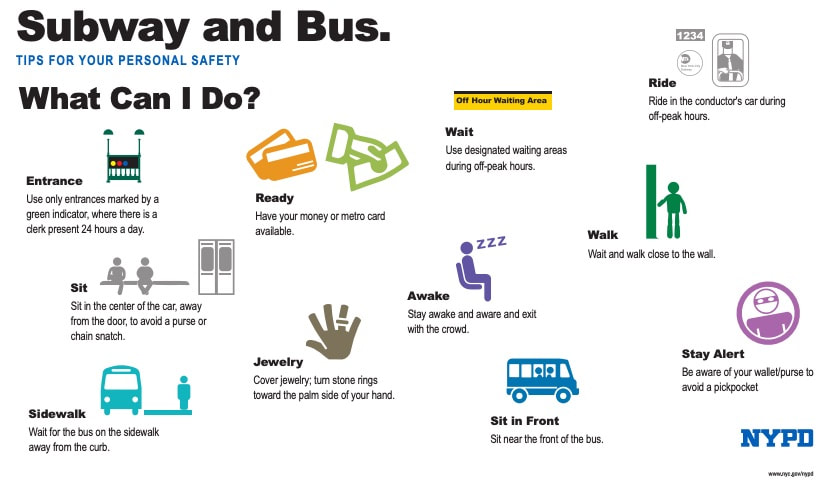 From the New York Times: "people will not have to show vaccination proof to visit restaurants, gyms and venues like movie theaters. Masks will still be required on public transit, and at Broadway theaters and some other places."
So masks/vaccination will not be required to enter many places, but please recognize that some locations/venues may have their own standards. I have been leading tours outside without a mask, mostly, though I can wear one on request, if the group is small enough and I can project. Some tour clients wear a mask even if they don't require me to wear one outdoors. (Personally, I may still be masking indoors and eating only outdoors.) 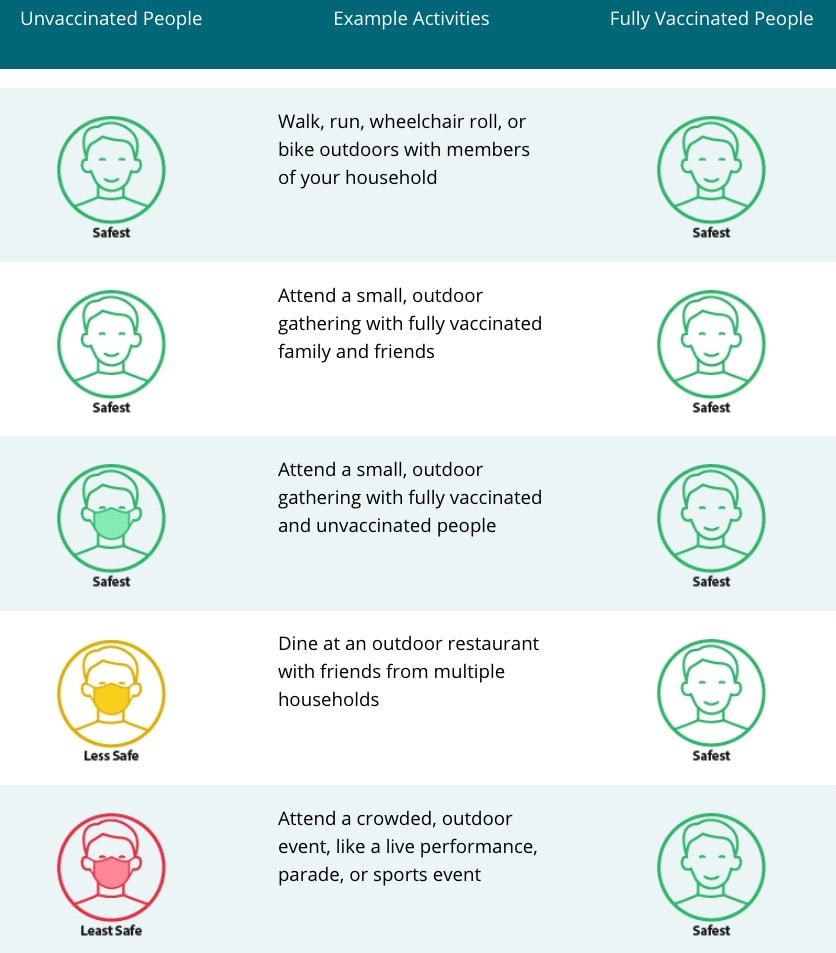 Updated Dec. 26, 2021 with new CDC guidelines. I am vaccinated (and boosted) and have been leading tours outside w/o masking, though I can of course wear a mask if preferred. According to the CDC's advice (pre-Delta variant), as per the New York Times, federal health officials have "advised that Americans who are fully vaccinated against the coronavirus may stop wearing masks or maintaining social distance in most indoor and outdoor settings, regardless of size." However, masks are still required in NYC on public transit and in stores. We can discuss. Regarding the Omicron variant, the CDC "continues to recommend wearing a mask in public indoor settings in areas of substantial or high community transmission, regardless of vaccination status." 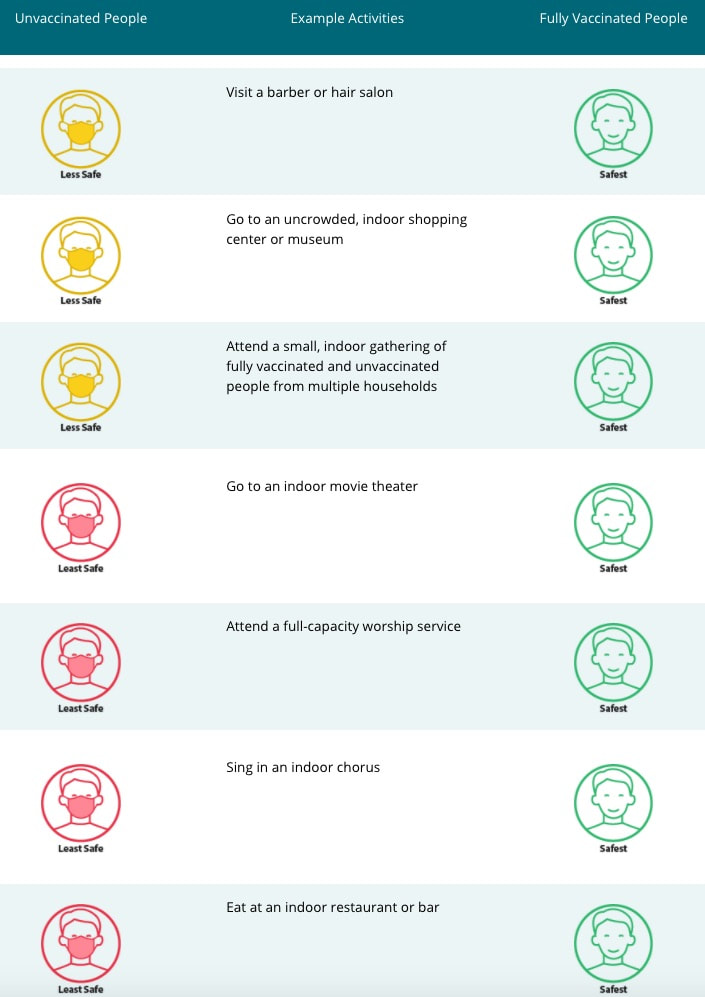 Leading a Socially Distant Tour in Pandemic Times: How a New Transmitter System Allows Adjustments12/28/2020 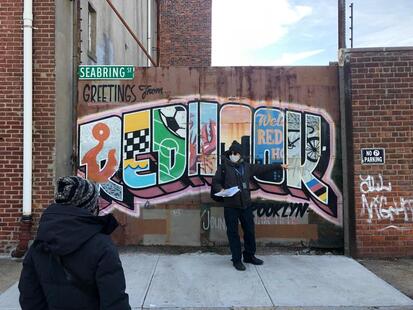 Photo: Jim Sailer Photo: Jim Sailer As you might imagine, the walking tour business has pretty much stalled since March, though I and some others have made a partial pivot to leading webinars, aka virtual tours.
But recently a previous client, who lives in Brooklyn, contacted me to organize a tour for a small family gathering. He expressed interest in two neighborhoods. I recommended Red Hook, which is not only very interesting, it's not very crowded, so perfect for social distancing. He started with just a handful of people, but when he said the group was up to 8, I decided to invest in a tour guide system, with a transmitter and 10 receivers with earphones, to ensure I could be heard while maintaining social distance. (I asked him to cap the group at 10; it wound up as 9 people.) I'd thought for a while about buying such a system to enhance options for visitors. (Meanwhile, new technologies are emerging to convert people's smartphones into receivers, and they can use their own earbuds. But I didn't have time to check that out.) The best-known name for such a system, and likely both the most expensive and the highest quality, is known as Whisper, which does not publish its prices for sale or rent. I bought a much cheaper competitor, perhaps a knock-off. Did it work? Well, mostly. I was able to speak into the lapel microphone, and the group could hear me from a good distance away, even those lagging a block or more behind. That saved time, because they didn't have to catch up to hear me, and it also allowed people to keep a healthy distance even when i wanted them relatively close, to show them images or a book. One flaw was static at certain times, perhaps related to wind. I'll need to test it out more. Bottom line: this adds an option at a time when walking tours are constrained. Yes, there's something lost when your face is covered, as the photo suggests, and your glasses change color. That said, it's still invigorating and interesting to be out there touring, especially when we can see things like this. Coming Dec. 18: A Webinar (Virtual Tour) About Coney Island's Heyday, the Turn of the 20th Century!11/21/2020 I'm looking forward to leading the second iteration of my new Coney Island webinar (aka Coney Island virtual tour), which will be a fast-paced narrated slideshow (plus a little video), Dec. 18 for New York Adventure Club: Coney Island, Pt. 1: The Heyday of the Amusement Age.
t's $10, and you don't have to watch it live--the video will be available for a week. Sign up here. It's a notably jam-packed slideshow--more than 300 slides. I've delved into the archives for some images and information I think a lot of people will find intriguing. (PS. Pt. 2 is coming.) 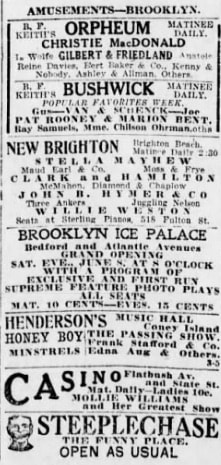 In researching my new Coney Island webinar (aka Coney Island virtual tour), audience members asked me: did Coney Island amusements close during the 1918 Flu Epidemic? The answer: no, as far as I can tell, and it's unclear how much attendance was affected. Yes, people were packed together for certain rides and attractions, as well as transportion to Coney, but surely there was less official concern about outdoor experiences. Though peak concerns came after the summer season, I'd suspect that worries about the flu had at least some impact. (I'll post an update if I learn more.) I couldn't find any mention in any books about the flu, and the evidence from the Brooklyn Daily Eagle is inconclusive. According to the Centers for Disease Control, the pandemic began, sporadically, in March 1918. At right is an excerpt from the June 7, 1918 Brooklyn Daily Eagle. Not only are movie houses open, Steeplechase Park is "Open As Usual." That seems a nod to the flu, since an advertisement from June 8, 1917 omitted such phrasing. The real peak, according to the CDC, came later: "Between September and November, a second wave of flu peaks in the United States. This second wave was highly fatal, and responsible for most of the deaths attributed to the pandemic. 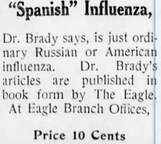 Yet Steeplechase was open--no "as usual" mention--according to this Sept. 13, 1918 ad from the Eagle. That said, I didn't see Steeplechase ad the following two weeks, though the movie houses were open. On Sept. 27, the city appropriated $25,000 to fight the flu, on a day 324 cases had been reported. There's one famous, but not necessarily credible anecdote, as cited in the Washington Post: "In New York there were accounts of people feeling perfectly healthy when they boarded the subway in Coney Island and being taken off dead when they reached Columbus Circle." But this discussion notes the absence of a primary source. On the left, an ad from the Sept. 30, 1918 Brooklyn Daily Eagle: "'Spanish' Influenza," according to the newspaper's expert, was "just ordinary Russian or American influenza." I don't think that was borne out by history. New York City, as of September, required "all flu cases to be isolated at home or in a city hospital," according to the CDC. Some 195,000 people died in October, across the country, part of an overall toll of 675,000 nationally, part of 50 million deaths worldwide. 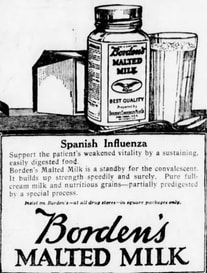 Indeed, as reported in the Oct. 5, 1918 Eagle, 2,070 new cases had been reported in one day, prompting "radical measures" to reduce congestion, including changing the hours at stores, theaters, and other places of business. But that was after the summer season at Coney Island. Indeed, Charles Denson of the Coney Island History Project recently observed that the crisis peaked in the off-season, so Coney "escaped the worst effects of the deadly 1918 flu." Interestingly--and relevant to today's public conflicts--health authorities decided not to close churches, but insisted on short services and open windows, with public announcements regarding the necessity of precautions, including "a request that all unguarded sneezing and coughing be refrained from." A similar announcement was required at theaters--but they weren't closed at the time, either. At right is an ad from the Oct. 18, 1918 Eagle, suggesting that those afflicted by the flu could build up strength by consuming Borden's Malted Milk. 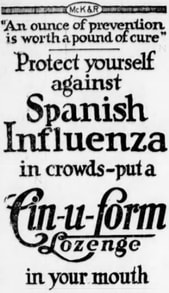 The flu was clearly a problem, as seen by advertisements in the Eagle for lozenges and quinine, seen as protection and therapeutic, respectively.
But masks, apparently, were not at issue. One casualty of the flu, according to the book Famous Nathan, is that Nathan's Famous founder Nathan Handwerker saw his Oct. 26 wedding plans derailed, with only 125 of 300 invitees attending--and many of them sick. By December, stores and factories nationally were encouraged to stagger opening and closing hours, and people were encouraged to avoid public transport to prevent overcrowding, according to the CDC. A third wave of the flu emerged in the winter and spring of 1919, subsiding in the summer and thus, apparently, sparing Coney Island. Still, an ad in the May 24, 1919 Eagle declared, with no caveats, that Steeplechase was "open for the season." So it looks like the amusement parks--Luna Park was open as well--endured with far less concern than in 2020. For example, this long March 2018 article about the flu, from the NYC Department of Records & Information Services, doesn't mention Coney. 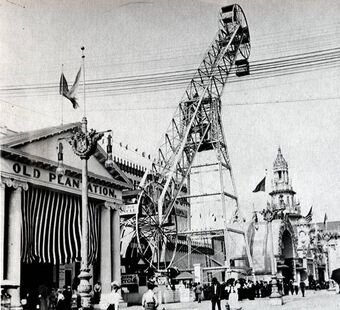 In researching my new Coney Island webinar (aka Coney Island virtual tour), I've delved deep into the influences on this famous amusement zone, notably the midways at various world's fairs. The 1901 Pan-American Exposition in Buffalo--a major city back then!--was a significant influence on Coney, since that's where Skip Dundy and Frederic Thompson became "Mighty Men of the Midway," designers and operators of an enormous range of attractions. The photo (via the fantastic Doing the Pan site) here focuses on the Aerio Cycle, a Thompson-devised mechanical fun device, which he had invented for a previous World's Fair, the Tennessee Centennial in Nashville, and would eventually make its way to Coney Island. But it's hard not to notice, stage left, Old Plantation, a very popular--and blatantly racist, albeit not by 1901 majority standards-- attraction, for which Thompson and Dundy were also responsible. What was Old Plantation? Thanks to the Uncrowned Queens Institute for Research & Education on Women, Inc. and its Uncrowned Community Builders Project, which focuses on the Black history in Western New York, we learn that the Old Plantation tried hard to recreate the pre-Civil War South, including "cotton and corn fields with real growing crops and slave cabins." One contemporary description said the attraction required the "services of 250 genuine southern cotton field Negroes in the portrayal of life on the plantation," while another called them "darkies who vary in age from tiny pickaninnies to white-headed uncles and aunties." Nightly minstrel shows, the Uncrowned project tells us, depicted scenes from plantation life, with performances by singers, banjo players, dancers and "Laughing Ben," a 96-year-old former slave. That means he was born in 1805 and, likely had spent nearly two-thirds of his life enslaved. That's ugly stuff, and a reminder of the palpable legacy of slavery. 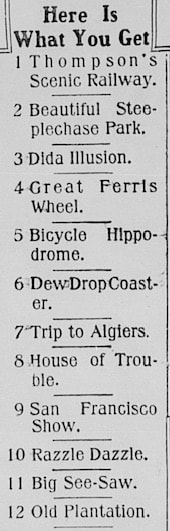 What happened at Coney Island? Many attractions from Buffalo came to Coney Island, notably Luna Park, the stunningly advanced amusement park that Thompson and Dundy opened in 1903. But none of the Luna Park advertisements I found mentioned Old Plantation, so I suspect it didn't move to Brooklyn from Buffalo. Still, they apparently tried. A Nov. 23, 1902 article from the Brooklyn Daily Eagle, previewing the amusement park under construction, said: "The romance of life in the Sunny South before the war will be portrayed in a reproduction of an an old plantation, showing scenes in the cotton fields and the old time darky pastimes and dances." Of course, it was not much of a "romance" for the people who were enslaved, and it's awful to think the majority culture took pleasure in it. Moving to Steeplechase A few years later, however, Steeplechase Park, a rival amusement park, was advertising Old Plantation as one of several attractions. See the excerpt at right from a Steeplechase advertisement in the June 30, 1906 New York Evening World, and look at the bottom. Old Plantation was presented as simply one of many Steeplechase features, including the ferris wheel, the "Big See-Saw" (the updated version of the Aerio Cycle), and the Razzle Dazzle. It's unclear if Old Plantation lasted past a year or two. The sole contemporary account I could find was from the June 30, 1907 Brooklyn Daily Eagle, which quoted a Steeplechase representative as saying, "In the performance called 'The Old Plantation,' the performers are all negroes, and some of them are very clever. They are professionals, having played with Williams and Walker and other colored stars." (That's a reference to the acclaimed vaudevillians George Walker and Bert Williams, cited in this essay for aiming "to tweak the popular music idiom of the day—which was dominated by a derogatory genre known as 'coon songs'—to render such songs either benign or ironic.") 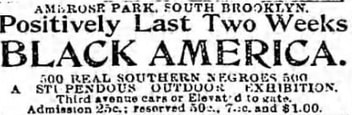 A troubling history
It didn't start with Old Plantation. Consider the image at right from the July 2, 1895 edition of the Brooklyn Daily Eagle. Even before the amusement parks emerged, during a time when circuses put "exotic" people on display, an exhibition was marketed of "Black America," with "500 Real Southern Negroes." (That was in "South Brooklyn," which at the time was considered the area around Gowanus/Sunset Park; in this case, Ambrose Park was at Third Avenue and 37th Street. Brooklyn initially was the central-west town, later city, within Kings County.) In the New York Times, Sam Roberts wrote a 2014 article about this phenomenon, noting that there's no record of any objection at the time. One headline at the time, he noted, cited the “Fun-Loving Darky of Old Slavery Days.” Interestingly enough, the promoter--according to researcher David Fiske--aimed to show "the better side of the colored man and woman of the South,” emphasizing their musical talents. Fiske notes that white locals were encouraged to visit Black America by their pastors, and it was, according to one 1947 article, “a first effort to make some presentation of the Negro as a person." That said, Fiske wrote that the absence of whites in the cast meant the absence of slavers: "Black America served not as a documentary of the life of blacks on antebellum plantations, but as a showcase of the talents and versatility of black people." Around the turn of the century, in fact, the brand name Old Plantation was used to sell both coffee and peaches, according to advertisements I found. Unfortunately, there's not a huge gap between that and the long-running brand of Aunt Jemima, whose operators only this year recognized they needed to stop profiting from racist stereotypes. 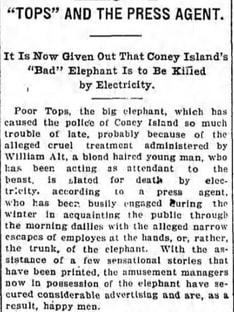 In researching my first Coney Island webinar (aka Coney Island virtual tour), about Coney up through the 1920s, I delved into the story of Topsy, the elephant that was unfortunately put to death in public in early 1903.
As we now know, elephants are soulful animals, and it's wrong to force them to perform in circuses, especially given the cruel techniques used to "train" them. But they didn't know that at the turn of the 20th century. Articles in the local press, like the Brooklyn Daily Eagle, referred to Topsy as a "Bad Elephant" or an "Angry Elephant." The latter was surely true, though the former less so: Topsy was angry for a good reason: she was regularly maltreated by his handlers, so much so that he killed a man. But the Dec. 13, 1902 Eagle article I've posted at right serves as an astonishing form of media criticism, and is--especially compared to other coverage--much more sympathetic. "Poor Tops," we're told, has caused the police "so much trouble of late, probably because of the alleged cruel treatment" by her attendant. The Eagle describes how a “press agent has been busily engaged" with tales employees narrowly escaping the elephant's purported wrath. "“With the assistance of a few sensational stories that have been printed," the article notes, " the amusement managers now in possession of the elephant have secured considerable advertising and are, as a result, happy men.” This is pretty sophisticated analysis of the way media stories often emerge, shaped by public relations people--"press agents," back then. And, yes, the next step, Topsy's ugly execution, was very much a media event, too. A new New York City report on furthering fair housing in New York aims, in the words of the press release, "to break down barriers to opportunity and build more integrated, equitable neighborhoods." Key goals of the plan include:
Below, I've highlighted a few graphics from the plans especially relevant to Brooklyn, with signs of gentrification; a shift in the black/white population in Central Brooklyn; a notable reliance on essential workers who commute long distances (such as from southern and eastern Brooklyn); a notable absence of public housing in southwest Brooklyn; a concentration of new construction in hot areas like Williamsburg and Downtown Brooklyn. 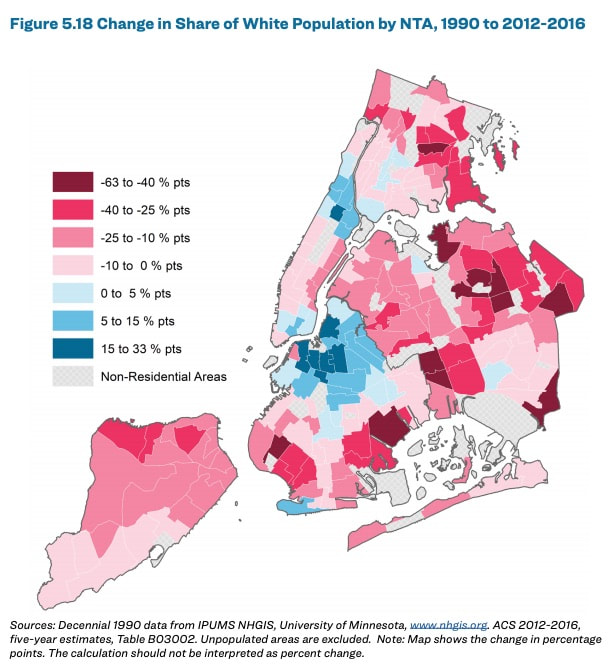 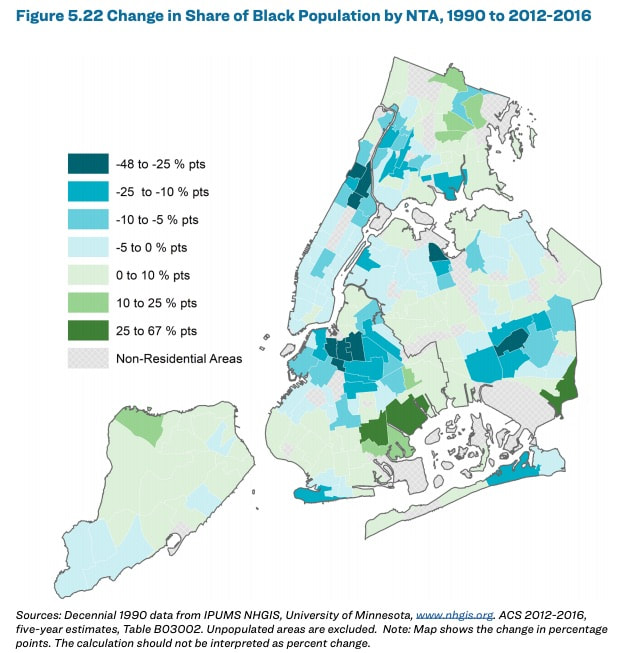 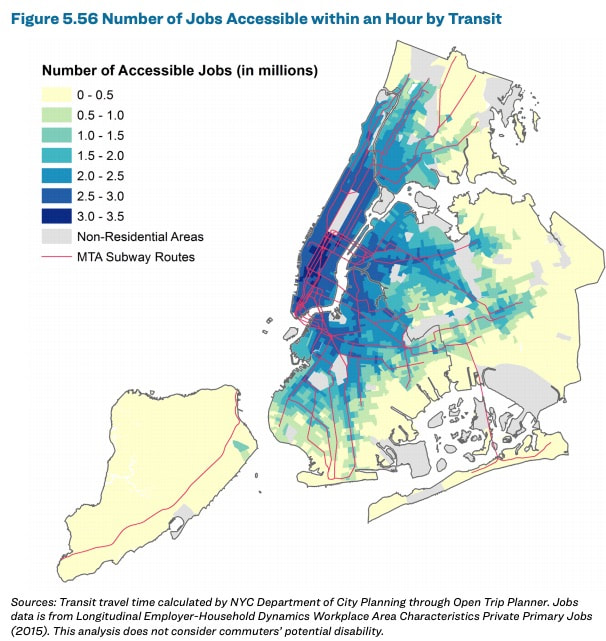 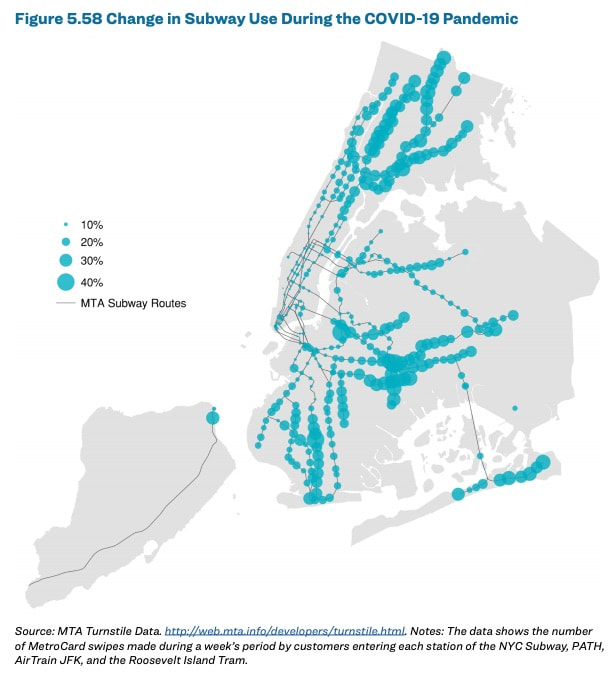 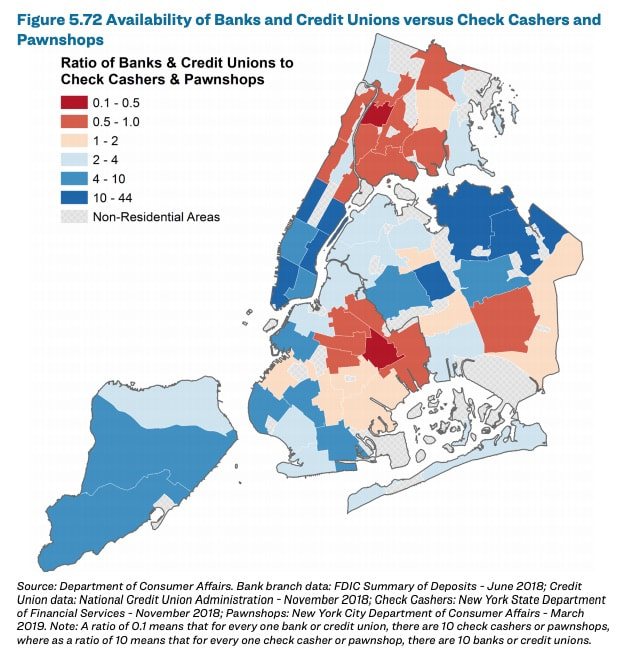 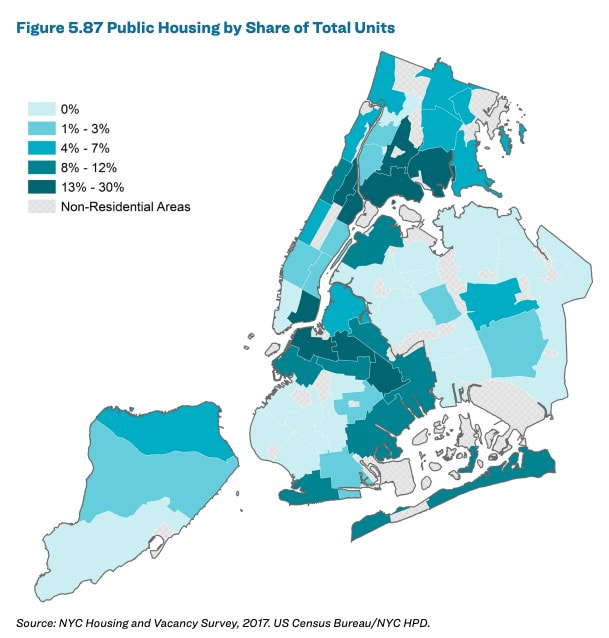 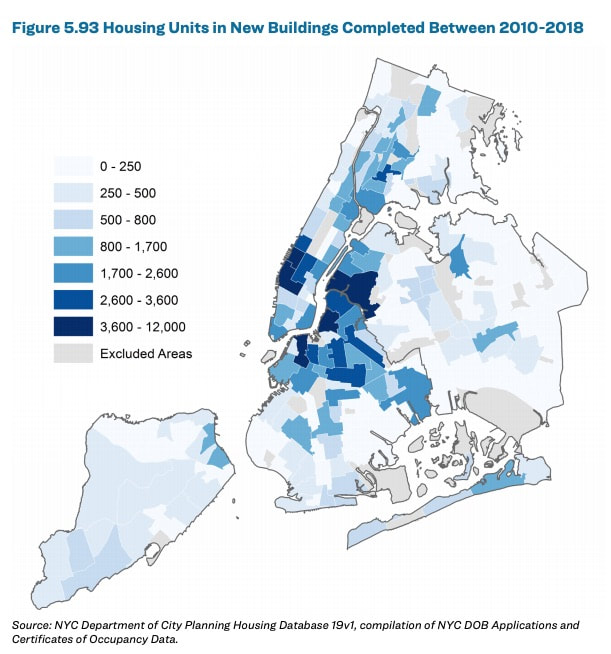 |
Touring Brooklyn BlogObservations and ephemera related to my tours and Brooklyn. Comments and questions are welcome--and moderated. Archives
July 2024
Categories
All
|
 RSS Feed